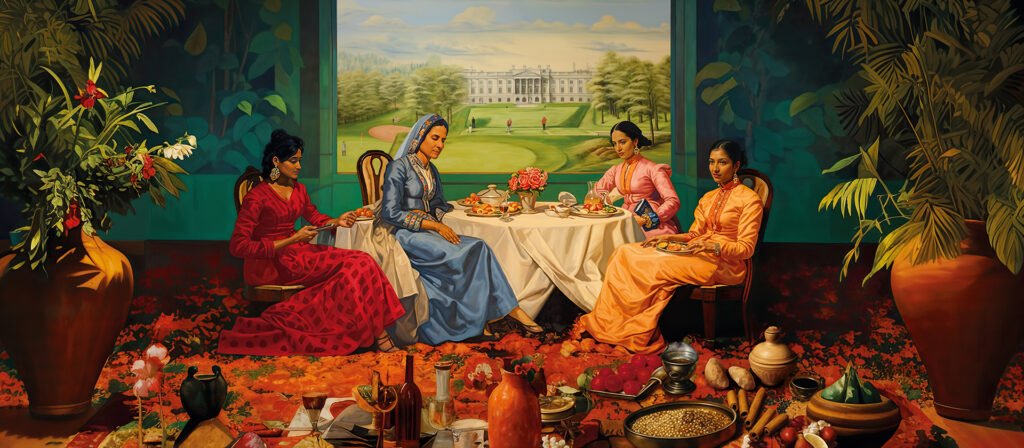
Afternoon Chai, 2023
Paper Size: 130 x 57 cm (including border)
Edition of 20
Supported by Parallel Gallery and signed by artist
£1,450.00
20% donated to 1834 Collective
Currently exhibited at DSQube, and previously exhibited at Attenborough Arts Centre and SPACE Gallery
Afternoon Chai by Sabrina Tirvengadum explores the hidden links between East London and the British East India Company, which once dominated world trade. The artwork is inspired by William Hogarth’s painting Assembly at Wanstead House (1728–1731). The original painting shows an upper-class family drinking tea and playing cards inside Wanstead House, a grand home built with money from colonial trade.
Sir Josiah Child, Governor of the East India Company, bought the Wanstead estate in the 1670s. He used his wealth to create large gardens and make the estate a symbol of power. His son Richard later built a Palladian mansion known as Wanstead House in 1722. Although it was demolished in 1825, its story still shapes the area, which is now Wanstead Park and Wanstead Golf Course.
In Afternoon Chai, Tirvengadum brings this history into the present. Four women of South Asian heritage sit around a richly decorated table with a view of Wanstead House behind them. Using AI image-making, archival photographs and digital painting, the artist portrays herself and her friends who grew up in Redbridge, the East London borough where the estate once stood. The table is filled with tea, spices, textiles and porcelain. These goods were once traded by the East India Company and are now part of everyday British life.
Among the group sits a friend’s mother, symbolising generations of storytelling and experiences. Through this work, Tirvengadum asks us to think about how trade, migration and empire continue to shape identity today. Afternoon Chai melds past and present, East and West, truth and fiction. The scenes through the window remind us that history’s remnants are present in today’s landscape, waiting to be rediscovered.
—–
Sabrina Tirvengadum (b. 1984) is a deaf British-Mauritian visual artist based in London, UK. They combine collage, photography, digital painting, and generative AI to explore identity, memory, and the ongoing legacies of colonial history. Drawing from family photographs and archives, Sabrina reimagines personal stories that reflect wider experiences of migration and belonging.
Other ways to support us!
Follow and share our content on social media